1 Stabilize
Assess what already exists: which cabling and active equipment works, what's at its limit, and what doesn't even have an up-to-date diagram. Without this, any new investment is built on assumptions.
 Book your free consultation
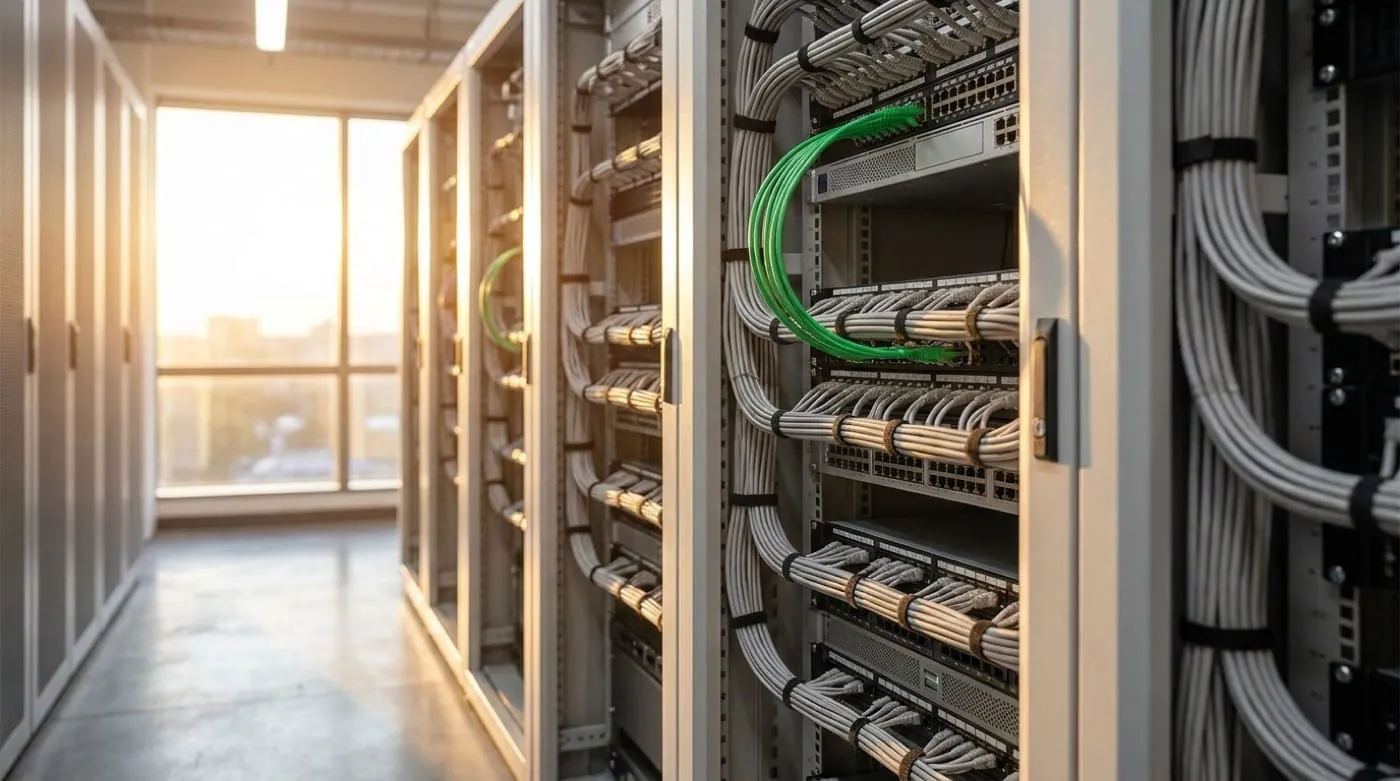
Short answer: enterprise IT infrastructure is the combination of networks, structured cabling, communication rooms, site-to-site connectivity, servers and devices that keeps a company's daily operation running. It's holding the business back when every new user or site forces improvisation instead of connecting to an already-defined standard. The right plan isn't buying equipment all at once: it's assessing the physical base, standardizing it, and then phasing growth around users, sites and IoT.
| Growth scenario | What to check first | Risk of skipping it |
|---|---|---|
| New site or branch | The cabling and switch standard to replicate, and the connectivity link available in that location | Every site ends up designed differently and becomes impossible to maintain as a whole |
| More users at the same location | Available network ports, switch capacity and real bandwidth (not the contracted one) | Silent saturation that shows up as “the network is slow” with no clear cause |
| IoT devices (cameras, sensors, access control) | Network segmentation (VLANs) to isolate critical traffic from user traffic | A compromised IoT device can expose the entire flat network |
| Remote or hybrid work | VPN capacity, access policies and authentication | Open access that nobody audits, until it becomes a security incident |
Assess what already exists: which cabling and active equipment works, what's at its limit, and what doesn't even have an up-to-date diagram. Without this, any new investment is built on assumptions.
Define a network, cabling and naming standard that can be replicated at every future site or expansion, instead of solving every project as a one-off case.
Grow users, sites or IoT devices on top of that already-ordered base, with planned capacity instead of reactive capacity.
Skipping step 1 is the most expensive mistake: buying new equipment on top of an undocumented base just moves the problem somewhere else.
It depends on the number of sites, users, the actual condition of the existing cabling, and how far the current network is from a documented standard. Any figure given without a prior diagnosis is a guess — the first step is always to assess what already exists before quoting what's missing.
It's not an all-or-nothing decision. It depends on how latency-sensitive your applications are, how stable your internet connectivity is, and which systems need to sit physically close to the user. Most companies end up with a hybrid setup, not a pure extreme.
There's no fixed schedule. Renewal should respond to concrete signals: hardware reaching end of life, real network saturation, new sites opening, or recurring incidents. Renewing on a calendar without evidence usually spends money where it isn't urgently needed.
Well-ordered IT infrastructure isn't bought all at once: it's diagnosed, standardized and scaled in stages. STI has been designing and implementing enterprise IT infrastructure in Guadalajara for 20 years, with 350+ projects delivered and an Alestra certification. Book a free initial diagnosis — no commitment and no catalog up front.